random thing but i realized it might be helpful for some people so uh. theres this thingy where you can upload an image and it gives you a color palette based on it !
heres an example
and it also gives you the hex code values for them too its p neat !
As a university student whose course load is heavily math-based, I’ve had my fair share of encounters with math problems that seem unsolvable, and notes that make absolutely no sense. Fortunately, I’ve also come across a lot of useful resources that I thought I would share with my fellow math comrades! So here is my list of “life-saving” math resources that will hopefully make your math life a little bit easier.
Definitely the most used resource when I am doing math homework. It’s capable of solving basically any math problem. You have to pay to see the step-by-step solution, and I have a shared account with my friend, so that’s an option if you want to pay a little bit less!
Similar to Wolfram Alpha, but free! You can see the step-by-step solutions without paying, so that’s great. However, the downside is that if your math problem is quite complicated, it may not have the solution (i.e. crazy integrals)
This website has notes on algebra to multivariable calculus, with plenty of examples and explanations.
This is an actual life saver for my friends who are doing advanced/university level math. Especially if your professor has atrocious writing but can’t seem to stray away from hand written notes.
Has video lessons on elementary to university level math. Great for visual learners, since the lessons include a lot of graphs and diagrams. Not to mention this website offers video lessons on a variety of subjects!
Textbook solutions!!! You can probably find the solutions to most of the calculus textbooks used in universities. Really great for those who like to study by doing a bunch of practice questions.
For those with professors who prefer digital submissions of assignments: turn your phone camera into a scanner without the bulk. The best scanner app I’ve come across – it will make your papers look like they’ve actually been scanned, even if you take the photo in bad lighting.
We all love disaster movies! The cool special effects, the underdog stories, the underlying themes of hope. As cool as they are, they do tend to use misconceptions about natural disasters. This normally wouldn’t be an issue since Hollywood will always embellish but it’s important to know the true science behind these phenomena should you ever encounter them.
1) Pyroclastic flows will kill you almost instantly, you cannot survive a direct hit
Movies guilty of this: Jurassic World: Fallen Kingdom, Dante’s Peak
Pyroclastic flows exceed 100km/h and reach temperatures over 1,000°C. You definitely cannot outrun it in either car or on foot. The boiling hot toxic gas, ash, and lava in the flow will kill you instantly and pummel your smoking corpse into oblivion. Sorry, Chris Pratt.
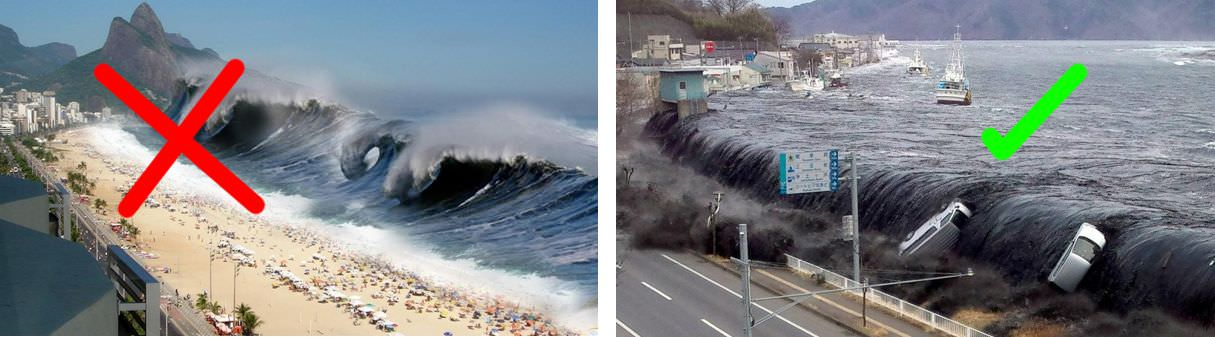
2) Tsunamis do not crest, they are more like a sudden flood than a wave
Movies guilty of this: Literally any movie with a tsunami ever
Tsunamis are massive and sudden floods caused by the displacement of ocean water due to earthquakes or massive landslides. They’re not tidal waves and thus do not crest. It’s poetic, but inaccurate.
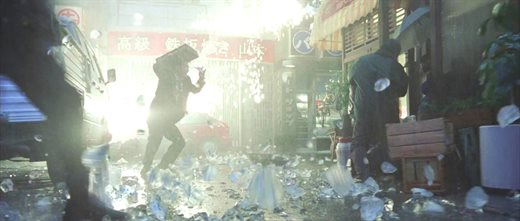
3) Hail is always spherical and doesn’t fall in big cinder blocks of ice
Movies guilty of this:The Day After Tomorrow
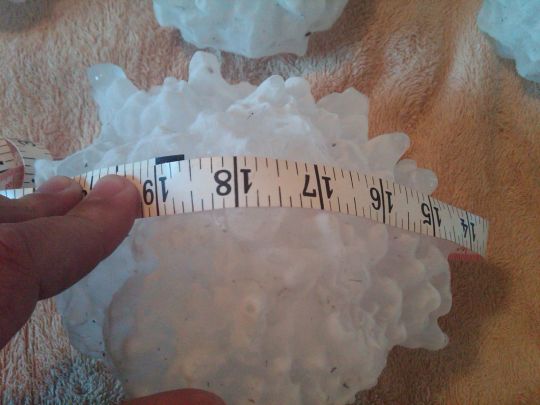
Hail can get quite large and can definitely be fatal, but they are exclusively spherical. Hail is formed by water droplets cycling through the updrafts of a thunderstorm and the rotational movements make the resulting hail a ball.
Looks more like a stage hand is throwing the remains of an ice swan than a hail storm
4) You cannot freeze instantaneously. Not even in space.
Movies guilty of this: The Day After Tomorrow, Geostorm, The Cloverfield Paradox, Sunshine
Space, and certain places on Earth, can get exceedingly cold. The coldest temperature ever recorded on Earth was −89.2 °C. That’s damn cold. But you still wouldn’t flash freeze into a peoplesicle within mere seconds. Intense cold can kill you quickly if you’re completely exposed but it would still take time before your body would be a thoroughly frozen chunk of meat. As for space, it can get quite cold, but it’s also an empty vacuum. There’s nothing around you but empty void, which means there’s also nothing to transfer your body heat away from you. Without convection, your body heat would be lost via radiation and that can take a long time.
5) Earthquakes over 10 on the Richter scale are physically impossible on Earth.
Movies guilty of this: 10.5
You would need a massive fault line to carry that sort of energy. Something on the scale of going through the earth’s core. Which does not exist . Even then, if such an earthquake would occur, the planet would literally explode.A 15 magnitude earthquake would release energy on the magnitude of 1×10^32 joules. That, coincidentally, is the same amount of energy contained in the gravitational binding of the Earth. Simply put, anything greater than 9.9 on the Richter scale is impossible and would cause the Earth to explode.
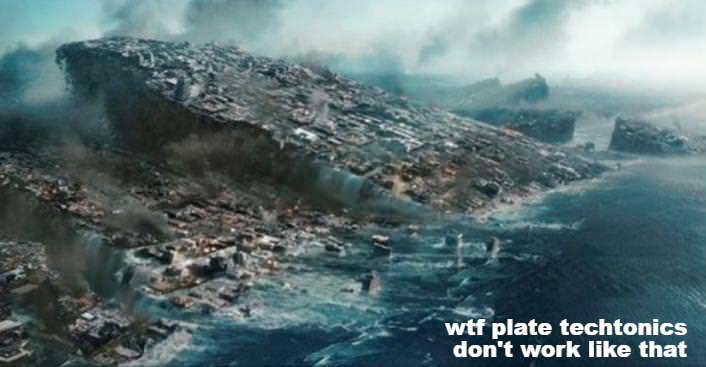
6) California will and can not sink into the Pacific like a big slab, and it can’t break away from the rest of the US.
Movies guilty of this: 2012, 10.5
Most movies cite the San Andreas fault as the reason for the cleavage, but even this isn’t enough. The San Andreas fault is a transform fault, meaning the North American plate and the Pacific Plate are slowly horizontally grinding past each other, not pushing away. As California is a part of the greater Pacific plate, it literally could not snap free from it to “sink into the sea”. Because if the entire tectonic plate underneath California where to flip over and sink then the entire ocean would drain away into the mantle.
7) You can’t sink in lava. You also can’t stand near it without being burned.
Movies guilty of this: Volcano, Lord of the Rings: Return of the King
Lava is molten rock, and is incredibly dense. In fact, it’s three times as dense as humans, who are mostly water. If you were to cannonball into a lava pit, you would dip in a bit before bouncing to the top and floating. You would also burn up and die super quickly. Because fresh lava can exceed 1,200°C! Even standing a couple feet away from a lava flow, you would feel the intense heat radiation. You would lose your eyebrows and probably the top layer of your skin if you stood too close. There’s a reason why volcanologists wear protective suits. Sam and Frodo would have been roasted.
Can we make one of this but with Anatomy, biology and microbiology facts against Horror and Slasher movies?? Some mistakes are funny to watch but they’re so common that they became annoying.
the bigger hailstones get, the less round they are, though you’re right that they’re not square.
the really big ones are spiky like a koosh ball of death, because they’re basically an icicle that grew in a wind tunnel.
It’s about time someone got around to uncovering all the cheat codes for this “human being” software. It’s only been out for like 10,000 years.
?????????????
I’ve used this technique for about a year, and I can safely say that it has efficiently transformed my sleeping habits from several hours of struggle to fall asleep, to passing out in a matter of minutes.
It’s a form of Alexander Technique. It’s a technique that was designed for actors to keep their body in ready working condition and give it the best way to perform. This is the method used to calm, and center the body. Once the body is at that point it can perform anything you want it to.
Reblogging for later reference after I tried it earlier today to try to calm down. It actually does help a lot, not just for sleep but if you have problems with anxiety.
My default mental setting is “vibrating intensely in the background.” After doing this, I felt noticeably calm and relaxed – I wasn’t as fixated on my breathing, I wasn’t tense, my movements weren’t jerky and I didn’t feel like I had to be as tense as possible to be under control. 10/10 would recommend.
me gonna try it
dont wanna reblog but insomnia is a bitch for some ppl so heres for my mutuals having trouble sleeping.
I use it for anxiety attacks. It works and I say this as someone who thought it was bullshit. I now have a timer at work set to one minute twenty seconds to do this exercise.
tips for people making identity flags: whether it looks pretty should be THE LAST thing on your list of priorities if you want it to be taken seriously as a flag
the first thing on your list should be: could I make an actual flag out of this, as in, physically sewing together strips of fabric? and if I can, would it be difficult or prohibitively expensive to do so and still have it be identifiable?
some things that will make it harder to do this:
multiple shades of the same color. the trans flag works because there are only three colors and they are all distinct from each other (pink, light blue, and white). I could conceivably go out and buy any shade of pink and light blue to make a physical trans flag and still have it be identifiable as a trans flag.
if instead I had to buy seven shades of blue, that would mean not only having to be sure that each shade was separate and distinct (I couldn’t just get any old blue), but also having to buy seven yards of fabric or seven skeins of yarn or seven skeins of embroidery thread. even if this were possible (for example, at most yarn stores it’s hard to find even two different shades of blue yarn in the same brand and size, let alone seven), it’s stupidly expensive.
also, side note: different shades of the same color are also not great for people who are colorblind.
colors that are uncommon. the hot pink stripe was removed from the original pride flag because it was hard to find hot pink fabric. colors that are easy to obtain are better for flags because they are more available. it would be hard to find yarn that DOESN’T come in the asexual pride flag colors (black, grey, white, and purple). colors like lilac, mauve, chartreuse, or peach are far more uncommon and likely would have to be specially dyed or ordered.
rule of thumb: the larger the box of crayola crayons needed to draw your flag, the less likely it is that someone will be able to physically make your flag. 8-count box? awesome. 72-count? not great.
too many unique colors. the rainbow flag gets a pass on this because they were specifically going for a rainbow, and nowadays it is common to get fabric, yarn, or thread specifically in pre-made rainbow colors. none of the rest of you get a pass. the more unique colors you have, the more skeins of yarn I’m going to need to buy.
notice that I’m not saying you can’t have more than a couple of stripes. the trans flag has five stripes; however, it has only three unique colors. most other flags have no more than four stripes if each stripe is a unique color (the ace flag, the nonbinary flag, and the proposed new lesbian flag, among others).
like, please, by all means, go out and make new flags. but please be aware of what flags are for. they’re not meant to stay only on the internet – they’re meant to be seen and used by a lot of different people, and that means making them accessible. please take this into account in your designs.
Candles are seen as the most powerful object for witches. If one lights a candle while reciting a chant or prayer for enlightenment, empowerment, and good health is one way to use a candle. One can also ward off negative energy and impart positive energy into one’s life using a candle also.
Historical Uses
Birthdays were the first ritual with candles used. Many believe the practice of wishing and blowing out the candle brought this wish to the gods who would grant it via the smoke.
Candles represent earth (wax), air (smoke), water (melted wax), and fire (flaming wick).
Magical Uses
Always be in the right frame of mind, or the spell will create an opposite effect intended
Allow candle to burn down on its own for most rituals
When the candle has extinguished itself, the spell will be complete
Some rituals and spells may ask for the candle to be extinguished and then re-lit the next day
Never leave a candle unattended
Give decent amounts of time for the candle to burn
Choosing a Candle
Magickally disinfecting your candles before using them is very important, since the energy from those who shipped it may linger on the wax. It is good to make your own candles from scratch for this reason also.
Avoid dipped candles such as white candles dipped into colored wax. Try to find ones solid color throughout
Cleansing Your Candle
Depending upon your preference, you can do a few things to cleanse your candle, such as leaving it outside for a week in the garden to soak up the moon’s rays at night.
For a less time-consuming cleansing, you may anoint your candle, using water and oils prior to the spell or ritual:
Wipe clean with a paper towel, removing all dirt
Prepare a solution of spring water, one teaspoon of sea salt, and warm until the salt dissolves. Allow to cool, and then pour back into the bottle. Keep this in the refrigerator for about a month for use over time.
Intent. Stand in front of your sink, hold the candle in your left hand (nearer to your heart). Be very careful not to wet the wick, and pour a small amount of the sea salt spring water solution over the candle. If using a tea-light candle for quick burn time, remove the candle from its casing before cleansing with the water. Take a fresh paper towel and dry the candle very well and say the following: “This magickal water cleanses thee, with good intent and purity” (Robbins and Bedell, 2017).
Inscribe the candle with a small, sharp knife or thick needle, and scratch your full name and your wish into the wax. It is not important that it be legible, nor the location where inscribed. The words will clout the spell more as the candle burns down.
To anoint your candle, pour some pure vegetable oil into a bowl. This oil is used for most anointing, but if using a spell for health and well-being, you may mix in a few drops of other oils if you wish. Lavender is common for health and well-being spells and will make the magick more intense. Hold the candle in your left hand again and dip the first finger of your right hand into the oil and run it down the candle from top to bottom in a line. If anointing a tea-light, place it back in its casing, dip your finger into the oil, and smear it in a clockwork motion around the top of the candle wax. Say this invocation: “This magickal oil anoints thee, with all things good, magickally” (Robbins and Bedell, 2017). The candle is now cleansed, charged, and ready to be placed in a suitable holder in preparation for the spell you choose.
Rhyming and repetition can help add punch to a spell. A lot of ancient and prewritten spells will rhyme with a poetic fluidity. Repeating the spell will give power to the message each time. The most magickal numbers that represent completion are 7, 9, and 12.
To end the spell, you will need to close the ritual. Choose one of the phrases such as “and so it is” or “the spell is cast” or “so mote it be” before looking upward and saying “thank you.”
Colorful Uses
The correct color is the most important thing with candle use
Some spells are exact to the color needed, and others more flexible
When in doubt, always use a white candle for it is neutral
Color Correspondances
White
Cleansing homes
Purifying spaces
Creating harmony
Invoking spirits
Improving communication with others
Summoning guides and angels
For use in every situation
Blue
Promoting restful sleep
Finding the truth
Gaining wisdom and knowledge
Invoking psychic visions
Calming emotions
Suppressing anger
Aiding meditation
Moving your house
Becoming more patient with others
Curing a fever
Having a better understanding
Protection
Red
Promoting strength and vigor
Rejuvenating energy and stamina
Conjuring willpower
Summoning courage
Inciting passion and sexual love
Sparking enthusiasm
Prompting quick results
Warding off enemies
Becoming more attractive to others
Pink
Healing emotions
Attracting romance
Becoming more caring
Inviting peace and tranquility
Healing rifts
Banishing selfish emotions
Protecting family and friendships
Invoking spiritual healing
Being more compassionate
Green
Accumulating money and wealth
Promoting prosperity and abundance
Accomplishing goals
Growing plants
Attracting luck
Negotiating employment matters and finding new jobs
Hastening conception and solving fertility issues
Casting out greed and resentment
Yellow
Increasing activity
Resolving health matters
Nurturing creativity and imagination
Passing exams and learning
Aiding concentration
Controlling mood swings
Protecting yourself when traveling
Persuading others
Healing problems associated with the head
Orange
Increasing energy and stamina
Improving the mind and memory
Promoting success and luck
Developing business and career
Helping those with new jobs
Clarifying legal matters and justice
Selling goods or houses
Capturing a thief or recovering lost property
Removing fear
Purple
Summoning spirit help
Bringing peace, tranquility, and harmony
Improving psychic ability
Aiding astral projection
Healing
Easing sadness
Improving male energy
Summoning spiritual protection
Brown
Attuning with the trees and earth
Promoting concentration
Helping with decisiveness
Protecting animals
Amplifying assertiveness
Aiding friendships
Bringing material gain
Gaining mental stability
Connecting with Mother Nature
Studying and learning
Silver
Summoning the Mother Goddess
Drawing down the moon
Connecting with lunar animals
Purifying female energy
Improving all psychic abilities
Aiding clairvoyance and the unconscious mind
Ridding negativity
Developing intuition
Interpreting messages in dreams
Banishing bad habits
Gold
healing and enhancing well-being
Rejuvenating yourself
Improving intelligence
Bringing financial gain and wealth
Winning competitions
Attracting love and happiness
Maintaining peace in families
Cosmic ordering
Black
Protection
Strength
Banishing
Reversal
Hex-breaking
Source
Robbins, Shawn, and Bedell, Charity. The Good Witch’s Guide. New York: Sterling Ethos, 2017. Print.
Classic Bookshelf: This site has put classic novels online, from Charles Dickens to Charlotte Bronte.
The Online Books Page: The University of Pennsylvania hosts this book search and database.
Project Gutenberg: This famous site has over 27,000 free books online.
Page by Page Books: Find books by Sir Arthur Conan Doyle and H.G. Wells, as well as speeches from George W. Bush on this site.
Classic Book Library: Genres here include historical fiction, history, science fiction, mystery, romance and children’s literature, but they’re all classics.
Classic Reader: Here you can read Shakespeare, young adult fiction and more.
Read Print: From George Orwell to Alexandre Dumas to George Eliot to Charles Darwin, this online library is stocked with the best classics.
Planet eBook: Download free classic literature titles here, from Dostoevsky to D.H. Lawrence to Joseph Conrad.
The Spectator Project: Montclair State University’s project features full-text, online versions of The Spectator and The Tatler.
Bibliomania: This site has more than 2,000 classic texts, plus study guides and reference books.
Online Library of Literature: Find full and unabridged texts of classic literature, including the Bronte sisters, Mark Twain and more.
Bartleby: Bartleby has much more than just the classics, but its collection of anthologies and other important novels made it famous.
Fiction.us: Fiction.us has a huge selection of novels, including works by Lewis Carroll, Willa Cather, Sherwood Anderson, Flaubert, George Eliot, F. Scott Fitzgerald and others.
Free Classic Literature: Find British authors like Shakespeare and Sir Arthur Conan Doyle, plus other authors like Jules Verne, Mark Twain, and more.
TEXTBOOKS
Textbook Revolution: Find biology, business, engineering, mathematics and world history textbooks here.
Wikibooks: From cookbooks to the computing department, find instructional and educational materials here.
Italian Women Writers: This site provides information about Italian women authors and features full-text titles too.
Biblioteca Valenciana: Register to use this database of Catalan and Valencian books.
Ketab Farsi: Access literature and publications in Farsi from this site.
Afghanistan Digital Library: Powered by NYU, the Afghanistan Digital Library has works published between 1870 and 1930.
CELT: CELT stands for “the Corpus of Electronic Texts” features important historical literature and documents.
Projekt Gutenberg-DE: This easy-to-use database of German language texts lets you search by genres and author.
HISTORY AND CULTURE
LibriVox: LibriVox has a good selection of historical fiction.
The Perseus Project: Tufts’ Perseus Digital Library features titles from Ancient Rome and Greece, published in English and original languages.
Access Genealogy: Find literature about Native American history, the Scotch-Irish immigration in the 19th and 20th centuries, and more.
Free History Books: This collection features U.S. history books, including works by Paul Jennings, Sarah Morgan Dawson, Josiah Quincy and others.
Most Popular History Books: Free titles include Seven Days and Seven Nights by Alexander Szegedy and Autobiography of a Female Slave by Martha G. Browne.
RARE BOOKS
Questia: Questia has 5,000 books available for free, including rare books and classics.
ARTS AND ENTERTAINMENT
Books-On-Line: This large collection includes movie scripts, newer works, cookbooks and more.
Chest of Books: This site has a wide range of free books, including gardening and cooking books, home improvement books, craft and hobby books, art books and more.
Free e-Books: Find titles related to beauty and fashion, games, health, drama and more.
2020ok: Categories here include art, graphic design, performing arts, ethnic and national, careers, business and a lot more.
Free Art Books: Find artist books and art books in PDF format here.
Free Web design books: OnlineComputerBooks.com directs you to free web design books.
Free Music Books: Find sheet music, lyrics and books about music here.
Free Fashion Books: Costume and fashion books are linked to the Google Books page.
MYSTERY
MysteryNet: Read free short mystery stories on this site.
TopMystery.com: Read books by Edgar Allan Poe, Sir Arthur Conan Doyle, GK Chesterton and other mystery writers here.
Mystery Books: Read books by Sue Grafton and others.
POETRY
The Literature Network: This site features forums, a copy of The King James Bible, and over 3,000 short stories and poems.
Poetry: This list includes “The Raven,” “O Captain! My Captain!” and “The Ballad of Bonnie and Clyde.”
Poem Hunter: Find free poems, lyrics and quotations on this site.
Famous Poetry Online: Read limericks, love poetry, and poems by Robert Browning, Emily Dickinson, John Donne, Lord Byron and others.
Google Poetry: Google Books has a large selection of poetry, fromThe Canterbury Tales to Beowulf to Walt Whitman.
QuotesandPoem.com: Read poems by Maya Angelou, William Blake, Sylvia Plath and more.
CompleteClassics.com: Rudyard Kipling, Allen Ginsberg and Alfred Lord Tennyson are all featured here.
PinkPoem.com: On this site, you can download free poetry ebooks.
MISC
Banned Books: Here you can follow links of banned books to their full text online.
World eBook Library: This monstrous collection includes classics, encyclopedias, children’s books and a lot more.
DailyLit: DailyLit has everything from Moby Dick to the recent phenomenon, Skinny Bitch.
when the capitalists die out either thru global warming or revolution will we be able to start homegrown internet
been reading about dual power and how to grow my own tomatoes and i’m wondering how and if we’ll be able to start commie internet lol
like obviously the internet is this huge electric capitalist controlled hardware infrastructure thing so after all that shuts down is there a way to do it ourselves lol
i want to come home from a hard day on the communal allotment, kiss my Wife, crank up my generator, and start sharing meams!
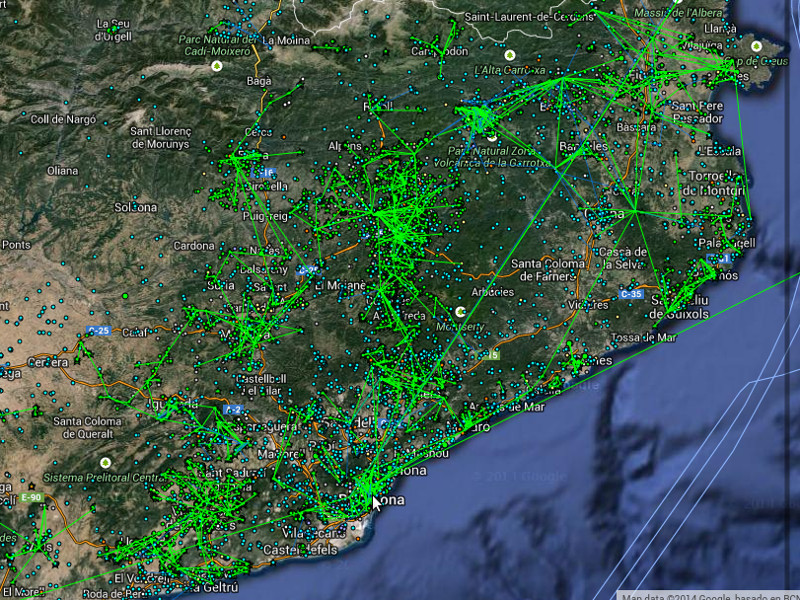
GOOD NEWS: the homegrown commie internet is in the works! Across the world, people fighting against censorship and for a more democratic internet are building mesh networks (meshnets) of long-range wifi (LoRa)
Since wifi is just a standard for sending data through radio waves, and radio waves can go a pretty long way if you use ‘em right, it’s not that difficult to connect two computers by wifi from across town. Then you just keep adding more computers to the network and you’ve got internet!
As for sharing fresh mëmês, the network to go to is Scuttlebutt. Unlike most social media, Scuttlebutt posts are stored on your computer and sent directly to your friends’ computers (rather than being stored on the cloud and sent to a central server). It works just fine over traditional internet, but you can also view and interact with it offline, and it has protocols for connecting over any means that two computers can share information – that includes LoRa, as well as hardwired connections, sneakernet (basically mailing a USB stick back and forth), etc
What that means is you always know that your info is just as safe as the network it’s sent on and the computer that receives it – no one even theoretically has the ability to collect and sell it all. And, since it’s all run on your computer, there’s no servers to go down or companies to go out of business that could destroy the whole thing
You can read more about this kind of stuff here (or here if it’s cloudy in Barcelona)!
I just discovered foodtimeline.org, which is exactly what it sounds like: centuries worth of information about FOOD. If you are writing something historical and you want a starting point for figuring out what people should be eating, this might be a good place?
CHRISTMAS CAME EARLY
this is awesome but the original link just turned into a redirect loop for me, here it is again (x)
The internet went from showing food recipe videos to alchemy in less than a decade. There’s going to be a quick video on how to make the philosopher’s stone from tomato sauce next week.

















 artherra