I’ve been trying to think of a good term for the “weepy movies about tragic queer people aimed at straight audiences” subgenre, and I think I’ve got it:
dead gays for the straight gaze
eh? eh??
queers die for the straight eye
SO YOOOO who wants to learn why this is a thing because the history is actually really fascinating and ties into some of my favorite shit ever?
Okay, so like, back in the mid-twentieth century, when being queer was still totally a crime everywhere in the United States, queer writers started working in pulp fiction–starting with Vin Packer (she is awesome)–and writing pulps to tell our stories.
So one day over lunch, her editor asks her, “Hey, Vin, what’s the story you most want to write?”
And she goes, “Well, I’d like to write a love story about lesbians because I’m, you know, gay.”
He says, “Hey, that’s awesome, I will publish it. One thing, though, the homosexuality has to end badly and the main character has to realize she was never gay in the first place. We can’t seem to support homosexuality. I don’t actually think that’s cool, but the government will literally seize our book shipments and destroy them on the basis of the books being ‘obscene’ if you don’t, so if we want this story actually out there, and not burning in a bonfire somewhere, it’s what you gotta do.”
So Vin goes home and writes Spring Fire, the book that launched the entire lesbian pulp genre. And while one character ends up in an insane asylum and the other ends up realizing she never loved her at all, it’s massively successful, and queer women everywhere snap it up and celebrate quietly in their closets across the nation because HOLY SHIT THERE’S A BOOK ABOUT ME? I’M NOT ALONE and it starts a huge new genre.
But: every publisher is subject to those same government censorship rules, so every story has to end unhappily for the queer characters, or else the book will never see the light of day. So, even though lesbian pulp helps solidify the queer civil rights movement, it’s having to do so subversively or else it’ll end up on the chopping block.
So blah blah blah, this goes on for about twentyyears, until finally in the seventies the censorship laws get relaxed, and people can actually start queer publishing houses! Yay! But the lesbian pulps, in the form they’d been known previously, basically start dying out.
MEANWHILE, OVER IN JAPAN! Yuri, or the “girls love” genre in manga, starts to emerge in the 1970s, and even starts dealing with trans characters in the stories. But, because of the same social mores that helped limit American lesbian pulp, the stories in Japan similarly must end in tragedy or else bad shit will go down for the authors and their books. Once more: tragic ends are the only way to see these stories published rather than destroyed.
The very first really successful yuri story has a younger, naive girl falling into a relationship with an older, more sophisticated girl, but the older girl ends up dying in the end, and subsequent artists/writers repeated the formula until it started getting subverted in the 1990s–again, twenty years later.
And to begin with cinema followed basically the same path as both lesbian pulps and yuri: when homosexuality is completely unacceptable in society, characters die or their stories otherwise end in tragedy, just to get the movies made, and a few come along to subvert that as things evolve.
But unlike the books and manga before them, even though queer people have become sightly more openly accepted, movies are stuck in a loop. See, pulps and yuri are considered pretty disposable, so they were allowed to evolve basically unfettered by concerns of being artistic or important enough to justify their existence, but film is considered art, and especially in snooty film critic circles, tragedy=art.
Since we, in the Western world, put films given Oscar nods on a pedestal, and Oscar nods go to critical darlings rather than boisterous blockbusters (the film equivalent of pulps, basically), and critics loooove their tragedy porn, filmmakers create queer stories that are tragic and ~beautiful~ that win awards that then inspire more queer stories that are tragic and ~beautiful~ until the market is oversaturated with this bullshit.
The Crying Game? Critical darling, tragic trans character.
Brokeback Mountain? Critical darling, tragic queer (? not totally sure if they’d consider themselves gay or bi, tbh?) characters.
And so on and so on VOILA, we now have a whole genre of tragedy porn for straight people, that started out as validation for us and sometimes even manages to slip some more through the cracks occasionally, but got co-opted by pretentious ~literary~ types. While tragic ends made these stories more acceptable to begin with, and in the mid-to-late nineties that started getting subverted a little bit (Chasing Amy, But I’m a Cheerleader), eventually that became the point, as more straight audiences started consuming these narratives and got all attached to the feels they got from the ~beauty of our pain~.
REVIEWS FOR VENOM JUST CAME IN AND IT’S A 28% ON ROTTEN TOMATOES!!!!!! THIS MOVIES GONNA BE SO FUCKIN FUNNY IM SO EXCITED. GOD I LOVE TERRIBLE SPIDERMAN MOVIES
“If you replaced Tom Hardy for Steve Martin in “All of Me,” and switched out Lily Tomlin for a wad of chewed-up black licorice, you’d have “Venom.”“
“When a major fight scene resembles a pair of black pants caught in a white wash, it’s fair to say you haven’t taken the audience with you.”
“It’s a train wreck of a movie, mixing and matching wildly dissonant tones, bizarre plot contrivances, and a truly unique lead performance.”
“Tom Hardy seems to be trying to be the first actor to win an Oscar and a Razzie for the same performance.”
“A film that feels like what you’d expect from a below average superhero flick circa 2004, like Ghost Rider or Fantastic Four.”
^ some of my fave critic review excerpts. i have never been more excited
some more
“The movie is so ridiculous that many viewers will at least be entertained in a dumbfounded way.”
“Think Affleck Daredevil. Think Ang Lee Hulk. Think Halle Berry Catwoman. That’s… I mean, that’s really all there is to be said, I think.”
“This is a movie that somehow slipped through a wormhole from 2004. That’s my biggest take. It’s a movie that spilled from the pre-MCU era through a crack in time and space… The humor, the story beats, everything right down to the Eminem theme song feels like it emerged Kimmy Schmidt style from a sealed off early ‘00s bunker.”
“Sorry to say that Venom is pretty much a complete failure — a tonal mess that feels 15 years old, ignoring the storytelling strides that the superhero genre has made in recent years.”
“Not sure I had the intended reactions to some scenes, but fun is fun — even when it’s totally ridiculous, right? It’s too bad they didn’t go for the R rating, though.”
“The cast seems to all know they’re in a darker superhero movie, except Tom Hardy who is basically remaking Jim Carrey’s Liar Liar.”
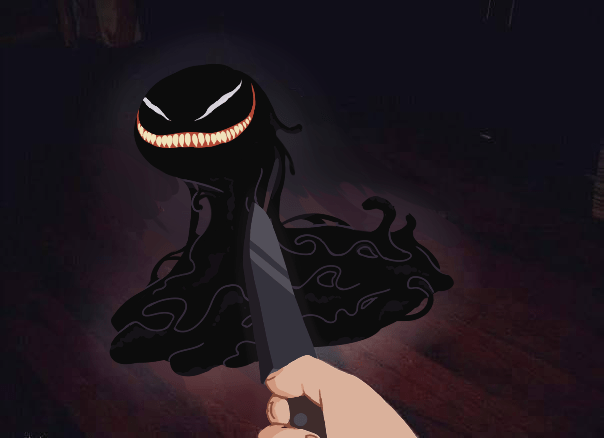
“At one point Tom Hardy and Venom make out.”
gonna go see it just for the make out honestly
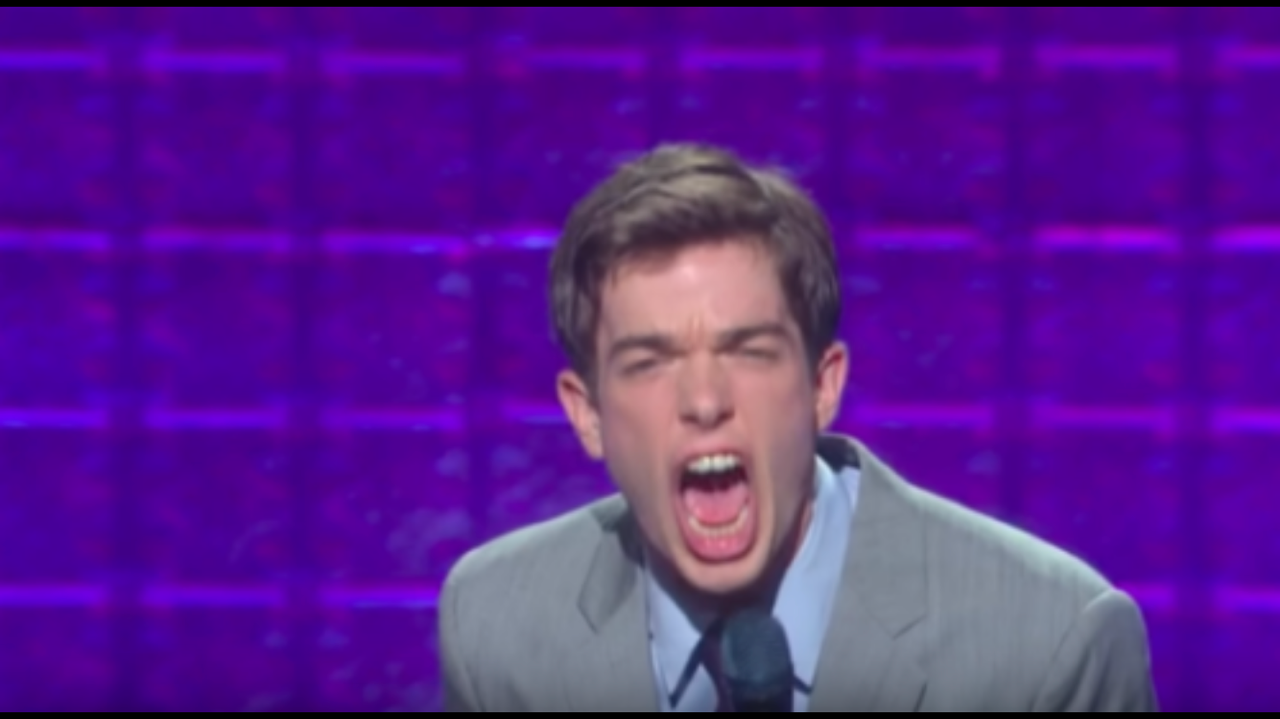
I was completely fine and then “At one point Tom Hardy and venom make out”
Miguel is right. The first time I watched it, I expected a later scene where Miguel was proven wrong or shown the error of his ways—one where it’s firmly established that adults might make rules that don’t make sense, but they have their reasons and it’s best to abide by their wishes.
But no. That doesn’t happen. Instead, we see that Imelda’s insistence on the music ban, and her refusal to reconsider, indirectly (or perhaps directly) land Miguel in even greater danger, as he wouldn’t have gone after de la Cruz were it not for Imelda insisting he give up music forever. The happy ending comes not when Miguel agrees to give up music to please his family, but when he defies the ban to save Héctor and restore Mama Coco’s memories.
I can’t tell you how many kid’s movies I’ve seen that would have taken “Family comes first” to mean “The adults’ wishes are paramount even if they’re unreasonable.” It would have been so easy to have Miguel simply go along with what Imelda wanted, but Pixar instead gave us a story where a child’s decision to contest an unfair rule is what eventually restores a broken family.
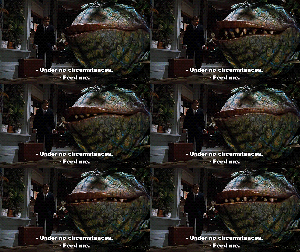
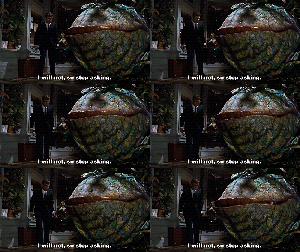
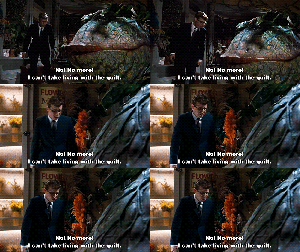
Look at this! Look at this fucking thing! This was done in 1986, and used absolutely no CGI whatsoever. It was ALL practical, and ALL done through puppetry. Look at the last gif. Over a dozen vines are moving at once along with its head, lips, and tongue! In interviews Rick Moranis has stated he often forgot he was working with a puppet, as opposed to a really ugly guy. Even today it looks so real. Audrey ii is nothing short of miraculous











 artherra