Have I watched the movie in the last decade or more? No. Do I have iron clad evidence to support my argument? Yes.
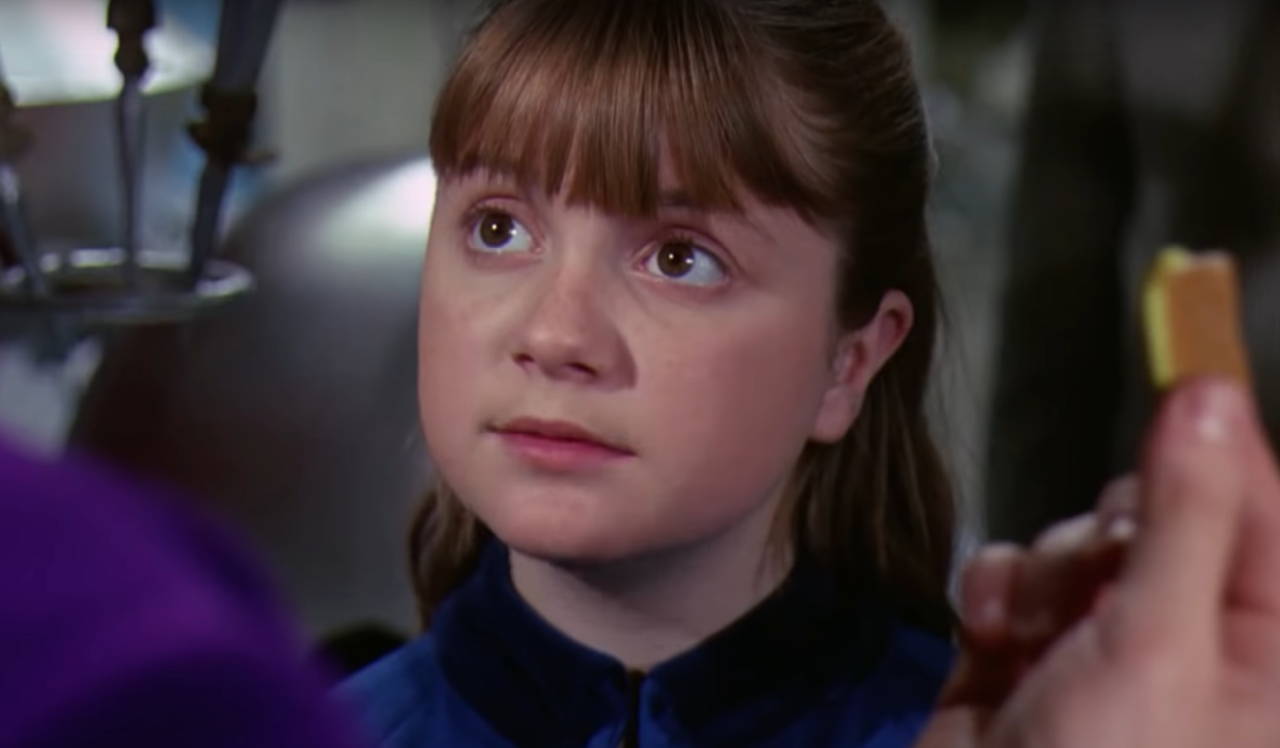
1. She’s the most knowledgeable about candy. She’s committed to it, and knows her stuff. When Wonka holds up a little yellow piece across the room, she recognizes it immediately. She was able to switch to candy bars for the sake of the contest, so we know she has personal discipline and is goal oriented. Also, two major projects play directly into her strong suits: the 3-course-meal gum that Wonka failed to make safe (gum) and the neverending gobstopper (longevity).
2. She’s the most fit to run a business. Violet is competitive, determined, hard working, and willing to take risks. Her father is a small town car salesman and politician, so she could easily pick up knowledge and support from him. (Veruca’s dad is also a business man, and in a compatible market (nuts), but it’s made very clear that Veruca has no respect or knowledge of business practices or hard work.)
3. She’s the most sympathetic to the Oompa Loompas. She critiques Veruca when Veruca demands to buy one. More importantly, Wonka has been testing the 3-course-meal gum that ‘always goes wrong’ on Oompa Loompas while he presumably just watches. Violet is ready to put herself on the front line, instead of treating the Oompa Loompas as disposable, and would therefore be a better boss.
4. Her personality ‘flaw’ is the most fitting for the company. In the moralizing Oompa Loompa song, they just say ‘gum is pretty cool, but it’s not socially acceptable to chew it all day‘. The thing is, we already know that she can stop if she wants, because she already did that to win the golden ticket. And yeah, she is defensive about the perceived impoliteness of her hobby (like when her mother tries to shame her about her habit during a televised interview) but the obsession with candy and neglect of social norms is EXACTLY what Wonka is all about. This is on brand.
5. Her misstep in the factory is reasonable. Wonka shows everyone a candy he’s very proud of. Violet is like “oh sick, that’s gum, my special interest.” Wonka is then pulls a “WRONG! It’s amazing gum!” So in the very moments before she takes the gum Wonka has mislead her just to belittle her. So when he’s like “I wouldn’t do that” why should she give a shit what he has to say? She’s not like Charlie over here who’s all “Sure Gramps, let’s stay behind while the tour leaves and secretly drink this thing that has been explicitly stated to fill you with gas and is too powerful for safe consumption, oh and also I just saw what happened to Violet so I actually KNOW what this stuff can be capable of” Also, Violet is not selfish about her experience, she tells everyone what she’s tasting and feeling, and everyone is eager to hear it. Taking a personal risk to share knowledge with everyone. Violet is Prometheus: fact.
So Augustus contaminates the chocolate river. Charlie sneaks around and contaminates the vent walls. Veruca destroys and disrupts the workspace. Mike knows exactly what will happen to him and transports/shrinks himself deliberately. Violet had no idea what the gum could potentially do to her, and caused no harm to anyone or anything but herself.
Lastly: Can you imagine Charlie filling Wonka’s shoes? That passive, naive boy? Violet is already basically Wonka. She’s passionate, sarcastic, candy-obsessed, free thinking, and a total firecracker. She’s even better than Wonka, because she doesn’t endanger others.
Violet should’ve been picked to inherit the chocolate factory.
How about we talk about what might have happened if Narnia hadn’t deserted Susan?
What if, instead of sending a stag to lead them astray, the Pevensies had been given time to end their first rule– to have finished their reports, their negotiations and treaties, that letter in the bureau Lucy was half-done penning to Mrs. Beaver to thank her for the fruitcake and to ask about her grandchildren.
They had lived there more than a decade then, grown from children to kings and queens, to brave young adults with responsibility heavy on their shoulders. They had lived through storms and wars, peace and joy, lost friends to battle and old age and distance. They had made a home. What if they had been given time to say good-bye?
What if we didn’t tell Susan she had to go grow up in her own world and then shame and punish her for doing just that? She was told to walk away and she went. She did not try to stay a child all her life, wishing for something she had been told she couldn’t have again.
There is nothing wrong with Lucy loving Narnia all her life, refusing an adulthood she didn’t want for a braver, brighter one she built herself. But there is also nothing wrong with Susan trying to find something new to fall in love with, something that might love her back.
You can build things in lipsticks and nylons, if you don’t mind getting a few runs in them. There is nothing wrong with wanting to be pretty, especially when pretty is the only power left to you.
Let’s talk about being the last one left. No, really, think about it. You get a call in the middle of the night, in the little flat you can just barely afford, and you are told there has been an accident.
Think about it, that moment– you scramble over everyone you know, everyone you love, and try to figure out where they all are that night. There are things rushing in your gut, your fingertips, your lungs, your ears– there are words in your ears as the tinny, sympathetic voice starts to tell you: it is everyone.
They were on a train. Something went wrong. They probably died instantly. A rushing sound. A bright light. (You try to imagine it, for years. You try not to think about it. You imagine it, for years–a rushing sound, a bright light.)
Your little sister, who you always felt the most responsible for, who you never understood, really– Your big brother, who disapproved of your choices but loved you with a steadiness you could never regret leaning into– Your little brother, a smug and arrogant ass except for the days when he drowned in self doubt– Ed was going to go far and you knew it, were waiting for it, were shoring up your defenses and your eye rolls for the days when he’d think he ruled the world–
Your mother is gone. Your father, with his stuffy cigar smell and big hands and the way he got distracted telling stories– he is gone. Your cousin Eustace, who suddenly lost that stick in his ass one summer. That friend of his, Jill, who you’d never actually quite met. Gone. A rushing sound. A bright light.
Go on. Walk through this with me. You can’t sleep all night long, because you still can’t understand it, still can’t quite breathe in a world where you are the last Pevensie. You finally fade sometime between midnight and dawn and when you wake up you don’t remember for half a second. You think ugh and you think sunshine why and then you remember that you are an orphan, an only child. You remember there probably isn’t anyone else to handle the funeral arrangements.
Get up. Make tea. Forget to eat breakfast and feel nauseous and empty all day. Call the people who need to be called. Your work, to ask for the time off. The mortuary, to ask about closed caskets. Distant relations. Friends. Edmund’s girlfriend and Peter’s boss. You listen to Lucy’s friends weep hysterics into the phone while you stare out the kitchen window and drink your fourth cup of tea. You call Professor Diggory, out at the old house with the wardrobe that started it all, and it rings and rings. You don’t find out for three days that he died in the train crash too. When you do, you stare at the newspaper article. You think of course.
You are twenty one years old. You have ruled a kingdom, fought and won and prevented wars, survived exile and school and your first day as a working woman. Nothing has ever felt worse than this. You have a necklace in your dresser you meant to give your mother, because she loves rubies and this glass is painted a nice ruby red and it is all you can afford on your tiny wages.
Excuse me, a correction: she loved rubies. She is dead. You never wear the necklace. You cry yourself to sleep for weeks. The first night you don’t cry, the first morning you wake up rested, you feel guilty. You wonder if that will live in the pit of your stomach all your life and you don’t know. The years reach out in front of you, miles and eons of loss. You are on the very shore of this grief and you do not know how you will survive feeling like this for the rest of your life. But you will survive it.
Get up. Make tea. Make yourself eat breakfast. Make plans with a school friend to do lunch. Go to work and try to bury yourself in the busyness of it. Remember that you’d promised to lend Peter a hand with some task or other, but you don’t even remember what it was– Collapse. Hide in the bathroom until you’re breathing again. Redo your makeup and leave work the moment your shift is over. Drop your nylons and your sweater and your heels in the apartment hallway. Fall into bed and pull the covers over your head.
Get up. Make tea. Eat. Don’t think about them for weeks. Don’t feel guilty when you remember. Feel proud. Spend an indulgent weekend in your pajamas, reading Lucy’s favorite novel and making Ed’s favorite cookies and remembering the way your mother smelled and how it always made you feel safe. Love them and miss them and mourn them. Keep breathing. Cry, but wash your face after in cool water. Wake in the morning to birdsong and spend three hours making breakfast just the way you like it.
Imagine the next birthday, the next Christmas, the next time you hit one of those days that herald the passage of time, that tell you how much you’ve grown and how much they haven’t.
Lucy, Peter, and Edmund will be at the same height for the rest of your life. Lucy will always be seventeen for the second time. You see, you think you know, when you lose them, what the dagger in you feels like. But it grows with you, that ache. You grow with it, too, learn how to live with that at your side but it grows, that ache, finds new ways to twist–
At the first friend’s wedding you go to, you cry because it’s lovely, those two smiling and promising and holding hands– but you also cry because you wonder what Lucy would have looked like in white, joyous and smiling and promising the rest of her life to a boy who deserved her.
Go on. You tell me if Susan deserted a world or if a whole life deserted her. You tell me who was left behind.
So yes, let’s talk about it– what if Narnia hadn’t deserted Susan? What if lipstick and nylons were things worn and not markers of worth?
What if we had a story that told little girls they could grow up to be anything they wanted– all of Lucy’s glory and light, Susan’s pretty face and parties, the way Jill could move so quiet and quick through the trees?
Because you know, some of those little girls? They were the little mothers, too old for their age, who worried and wondered, who couldn’t believe like Lucy or charge like Jill. Susan was reasonable, was hesitant and beautiful and gentle, was pretty and silly and growing up, and for it she was lost. She was left. And when Susan was left, so were they.
The little girls who worried louder than they loved, who were nervous about climbing trees and who would never run after the mirage of a lion, who looked at the pretty women in the grocery store and wondered if they would grow up pretty too– some of them looked at their little clever doubting hands, after they read Peter and Eustace and Jill scoffing at Susan’s vanities, and they wondered what they were worth.
Imagine a Narnia that believed in all of them. Imagine a Narnia that believed in adult women, lipsticked or not. Imagine Susan teaching Jill how to string a bow, arms straining. Imagine her brushing blush on Lucy’s cheeks, the first time Lu went out walking with a boy she was considering falling in love with. Imagine that when the last door to Narnia was shut, there was not a sister left behind.
Cinderella “plot holes” I am tired of hearing about
“Why didn’t her step family recognize her?” Because royal balls were basically the candle lit equivalent of clubbing in terms of both lighting and sheer numbers. Even if they were right next to her, they probably wouldn’t get a good look, especially since it would have started after sundown. Also, she was the help; they probably hadn’t looked at her in years.
“Looking for someone based on their shoe size is stupid!” See above.
“Was he going to have every size seven in the kingdom try the slipper on?” Prior to industrialization most garments were made by hand to fit the buyer’s measurements, including shoes. It’s why poor people only had one pair. It’s a lot smarter when you consider that they would’ve fit her like a glove.
“You can’t run down stairs in heels!” I know this is a misconception resulting from historical revisionism and disneyfication, but high heels were not originally women’s shoes. They were worn by men. Women wore slippers, which were basically ballet flats. So it’s debatable.
“Glass shoes don’t make any sense!” Okay first of all, it’s called the suspension of disbelief, and secondly, they’re gold in every other version but Perrault decided to change them to something else expensive.
“She just went to the ball to find a man!” I know this isn’t a plot hole but listen. As the daughter of a widower Cinderella would’ve been running the household finances and acting as hostess if he hadn’t remarried. By demoting Cinderella to a servant, her step-mother essentially guaranteed that she would never escape the house, because the only way for her to escape and maintain her status was to marry well, and no one was going to marry a servant. It was essentially the historical equivalent of your mom stealing your college acceptance letters out of the mailbox.
this was not an analysis i was prepared for, i’ll tell you that
They used the implication that Jared and Jensen aren’t friends anymore at least 6 times in The French Mistake. The first time I watched it, I thought they were playing on the whole spoiled, douche actor stereotype and that it was leading to some punchline about Jensen having a bigger trailer or Jared getting top billing. But that never happened- instead they just repeated it over and over. In fact, it’s the last line of the episode. I could never understand the purpose because everyone knows that Jensen and Jared are extremely close in real life.
When I rewatched it a couple of weeks ago, I finally got it. The title of the episode comes from the scene in the movie Blazing Saddles where the cowboy movie literally breaks through the fourth wall and into the set of a musical called The French Mistake. In an interview, Mel Brooks explained that a “French mistake” is when two supposedly heterosexual men have sex in the heat of the moment and then regret it afterwards.
Get it? It’s a big J2 joke. In that parallel universe, Jensen and Jared did something they regret and now they don’t talk.
So not only is Supernatural the first show that included their characters’ shippers (with the Wincest mention in The Monster at the End of this Book andthen by creating Becky and later by including lots of ships in the Fan Fiction episode), but it’s the first show that I know of that gave a wink to people who ship its actors. God bless this show.
You know, with all the language throughout Star Wars about “giving in” to the Dark Side, how the Dark Side makes you more powerful, how the Dark Side makes you age strangely and destroys you, it sure doesn’t sound like an “opposite side of the coin” so much as the “deeper end of the pool,” like it’s actually the true form of the force and being a Jedi is about keeping it tamed so it doesn’t eat you the way it actually wants.
the force is entropy
Eldritch Jedi pls
This is one of the reasons i love the second Knights of the Old Republic game, wherein one of the major characters (who defines herself neither as Jedi nor Sith) actually views the Force this way, saying “I hate the Force. I hate that it seems to have a will, that it would control us to achieve some measure of balance, when countless lives are lost.”
It’s also the game that gave us the two most entropic, eldritch characters in the franchise: Darth Nihilus, whose dark-side-borne ability to feed on the Force and consume life itself has twisted him into a half-living “wound in the Force”, more presence than flesh
and Darth Sion, whose entire body is a ruin, his flesh nothing but ragged scar tissue, every bone and muscle broken and torn, kept animated by will alone as he forces himself, second by agonizing second, to exist
I wish there were more horrifying perspectives on the force like that
This is one of the reasons the term “Light Side” never felt right to me, even before it was used in any official media; The Force always struck me more like an ocean than a binary concept: the deeper you go, the darker and more crushing it gets — at a certain point becoming an effectually consistent darkness — and while light filters down and fades for some distance, if there is a truly light “side” it’d be the surface.
Which isn’t to say “the Force is evil unless you flounder about near the top” — just that it’s a natural force, and as such is something you need to respect and be adequately prepared for. (Take electricity, for example: super awesome and pretty dang useful, but OH HOLY SMOKES don’t try and harness it unless you REALLY know what you’re doing!)
In this sense, being tempted by the Dark Side is less a case of “Hey, I wonder what’s on the other side of this coin it looks pretty cool haha oh whoops I’m Space Walter White now,” and more one of “The deeper into this thing you go, the harder you’ll need to fight to resist the ever-increasing pressure, to remain whole, even to just see whatever the heck you’re actually doing.”
(which is why Jedi training is so important: those padawans gotta build themselves a mental Deepsea Challenger!)
THIS META BLESSED ME
Okay but let’s suppose, for a moment, that the Force is actually malevolent.
That would make a lot of sense.
Consider, for a moment, an eldritch parasite. This ancient being feeds off of the life-force of other creatures. Not that unusual, as most living things also consume other living things, to various degrees. But this one is technically somewhat removed from the usual structures of biology. It is a passive and opportunistic predator, for the most part. Whenever a living being that is connected to it – however weakly – dies, it consumes part of its energy, and gets bigger.
As life in the galaxy flourishes, and time passes, this singular entity gets bigger, and bigger, and bigger. Like a catfish; the only limit to its growth is how much it can consume to fuel it. The larger it gets, the more it is able to sink its invisible claws into other living beings, until eventually there is hardly any life out there which hasn’t been ‘infected’ by it, and slated to become its spiritual dinner as soon as its biological form gives out.
And here we actually come to – of all things – the midichlorians. Which, the Jedi use to measure someone’s sensitivity to the Force, which works because midichlorians are the vehicle for the predatory parasite to infest living beings. The immune systems in some people begin to develop a certain degree of resistance to them, which is why some folks have more, and some have less, and this directly correlates to their Force sensitivity. The more midichlorians you have, the worse your immune system is at fending off the parasite.
The Force counters the risk of being bred out of subsequent generations by developing camouflage, and adapting itself into a more seemingly-symbiotic relationship with its prey.
What the Jedi see as the ‘light side’ of the Force, is a reflective layer that this predator has created via its connection to all living things. This network is the honey trap that encourages the beings still strongly connected to it, to spread that connection, because it affords them advantages while they are still alive. But its elements are comprised mostly of echoes and reflections of their fellow prey organisms. Force Ghosts that resemble the departed. Emotions that are transmitted along this layer and between individuals. Small amounts of power that can be siphoned off to impact the environment, and can also spread the Force to whatever living thing it comes into contact with.
This being is huge now, it needs a lot of juice in order to maintain its existence, let along continue to grow. And like most predators it’s willing to expend a certain amount of energy in order to guarantee a bigger pay-off.
The deeper you go into the Force, the more the Force starts exerting its own will through you. And the less you see of the reflected camouflage of it, and the more apparent it becomes that the Force wants large swaths of death to feed it. Which is why Dark Siders often become so preoccupied with things like Death Stars.
But it’s a balancing act. A large population of relatively peaceful Force sensitives, like the Jedi, cost more than they’re worth, because beyond a point they take too much energy from the Force and don’t kill enough people to pay for it. A single individual abusing their powers for self-gain and murdering left and right, though, accomplishes the goal of feeding it. The Force obviously doesn’t want its food supply to die out completely, but this explains the persistent cycles of the Star Wars universe – as a soon as a group of peaceful Force users becomes prominent, they get wiped out by a few Dark Siders who have tread too deeply past the reflective surface of the Force, and become actual vessels for its will.
And then when the Dark Siders have finished killing a whole bunch of people, it’s time for them to go, too, so that they don’t wipe out the entire populace and kill off the Force’s food supply beyond its ability to reasonably recover. The peaceful types then see an upswing, as they are more adept at spreading the Force. So the cycle goes – Jedi spread the Force, Sith kill the Jedi and feed the Force, Jedi kill the Sith and resume spreading the Force. It’s a planting and harvest cycle, and the galaxy is populated with the Force’s living spirit crops. Anakin Skywalker, who was arguably one of the beings most closely connected to the Force, and had an extremely high midichlorian count, basically lived this cycle in its entirety as an individual – he spread the Force as a Jedi, he killed people as a Sith, and then he ended it all in order to preserve his progeny for the next round.
tl;dr – the Force wants to eat your soul. The reason the ‘light side’ types always get so up in their own asses is because what they perceive as the Force is basically their own reflections dangling in front of them like an angler fish’s lure. The reason the ‘dark side’ types get so messed up is because they’re basically the equivalent of those grasshoppers who get infected with a parasite that makes them drown themselves.
This point of view would actually explain both No-Attachment rule and the Order’s cradle-robbing – some more self-aware Jedi saw the Force for what it is and pushed for a rule that potentially would cut births of Force-sensitive kids to a bare minimum. And those who were born Force-sensitive thanks to a quirk of the Force are to be taken from the society in the quickest way possible before they mess up, given tools to keep it at bay, and indoctrinated to never want to dabble in the deeper ends of their ability. It would also explain the whole debacle of Unifying vs Living Force and why Jedi seem to prefer the former – all of the description of the Living Force I came across present it as more ever changing, nearly organic entity and Jedi that use is as more responsive to its nudges, so potentially more inclined to being “corrupted” by it.



 artherra